Citizen Writes
Research hot topics
25 years of the National Space Centre
22/07/2026
Professor Martin Barstow, Professor of Astrophysics and Space Science, recalls how Leicester became home to a world-class, space-based visitor attraction.
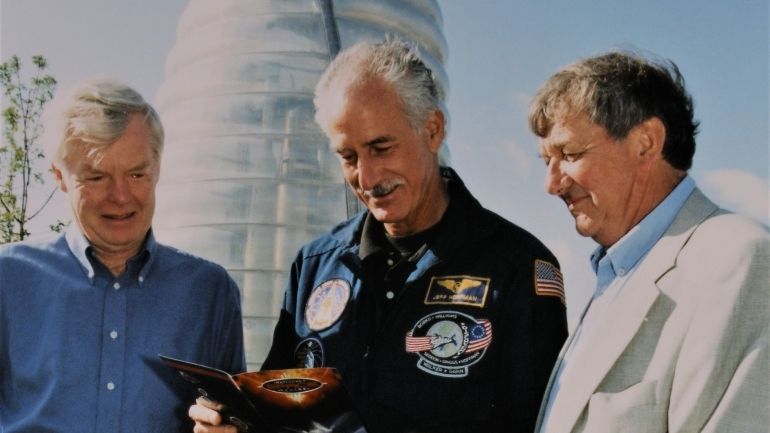
Ken Pounds, Jeff Hoffman and Alan Wells at the opening of the National Space Centre in 2001.
The National Space Centre in Leicester celebrated its 25th anniversary on 30 June 2026. I find it hard to believe that a quarter of a century has passed since the doors were first opened by our friend and former colleague, NASA astronaut Jeff Hoffman. My memory is of a nice sunny day as we waited outside for Jeff to cut the ribbon to unleash the visitors on the unsuspecting exhibits. These had been thoroughly tested a few weeks earlier by members of the University and their families, and some hadn’t survived. I hoped that the lessons had been learned! However, my overwhelming feeling was one of excitement to see how the public would enjoy what we had delivered. Even now, when I am at the NSC for meetings and events, I still get a huge buzz from seeing the enjoyment of those who visit.
There is no doubt that the NSC has been an enormous success, by all measures. Since it opened, more than six million visitors have been welcomed, an average of around a quarter of a million per year. However, hidden inside these figures is an even more important statistic, that roughly 80,000 of these annual visitors are from schools, participating in the NSC’s education programmes, helping to promote science education and making an essential contribution to the scientifically literate work force that the country needs. I estimate that the NSC has influenced around two million school students since it opened.
This success was not guaranteed. When the idea of pitching to the Millennium Commission for funding a space visitor attraction and education facility was first proposed, there was a lot of scepticism. Within the University, we were enormously enthusiastic, but we had to turn that into a reasoned case and overcome the “Why Leicester?” question often used to limit our ambition. Earlier thoughts about a space centre in Leicester had been unfulfilled, but a growing confidence in our importance as a space community in the UK with a developed and structured outreach programme coincided with the timely opportunity offered by National Lottery money.
A lot of work was required to turn the basic idea of a visitor centre into a reality by 2001, the target for the Millennium Commission. As the outreach lead for the Department of Physics and Astronomy, I had a central role in helping develop the ideas and contribute to the bid writing, but this was a major team effort, led by Alan Wells, Alan Ponter and Nigel Siesage from the University and, when the City Council quickly became involved, Peter Soulsby, its leader. That was the start of what is now a long-standing and productive partnership, developing space locally, leading to Space Park Leicester and Leicester as ‘Space City’.
I remain proud of my own contributions. I put a lot of work into the development of the Challenger Learning Centre, helping secure the first such facility outside North America. I also led the development of the ‘Space Now’ gallery, a vehicle for bringing the latest exciting news from space to the centre, as the static galleries couldn’t be updated quickly enough. This still exists, but much improved and updated with current technology. For the astronomy gallery, I had to write to the Smithsonian Institution in the USA to secure, on loan, some engineering models of the IUE and IRAS satellites, in which the UK had played important roles.
The road to delivering the project was not a smooth one. There were many stages of proposal development and potential pushbacks. For a while there was even a rival space bid from Derby! In that case the question of “Why Derby?” was certainly justified. It had no experience base and quickly evaporated. There was the small matter of finding half the £52 million funding from donations and sponsors. That was a hard challenge, with lots of often fruitless meetings. We slowly got there, but I remember that Leicester City Council had to step in with a contribution, at the end, to ensure the project’s progress. Thank you, City Council!
After six years of hard work, we finally got to that opening day. What a day, and what a lot of great days since. Unlike other ‘national’ museums, the NSC receives no direct government funding. Nevertheless, through its own visitor income, sponsorship and competitively won grants, the NSC has been maintained, refurbished and developed through the past 25 years. I recently attended the opening of the refurbished Solar System gallery, which has some truly stunning new presentation technology. I was amazed by the visualisation of the methane rain on Titan and the frozen volcanoes on Triton. It has been a highlight of my life to be involved with the NSC. Happy 25th birthday!